
Why Your Dog Pulls On The Leash-And How To Start Fixing It
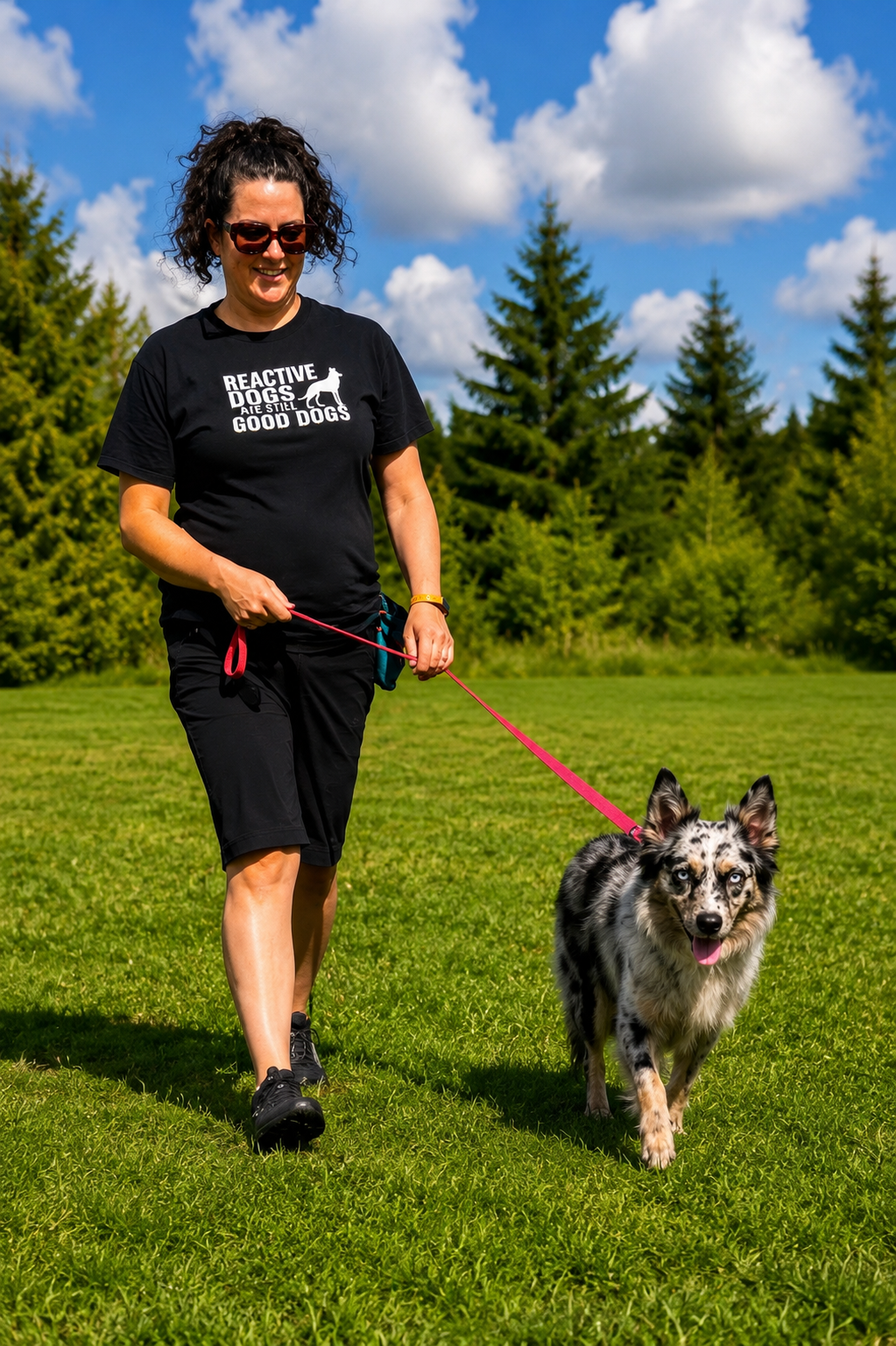
If walking your dog feels less like a relaxing stroll and more like being towed down the road by a four-legged freight train, you’re definitely not alone.
Leash pulling is one of the most common problems I help owners with, and there’s a pretty simple reason it becomes so persistent:
Pulling works.
Your dog wants to get to the interesting smell, so they pull and you veer off course and they get to the smell. They want to reach the tree, the person, the dog or the patch of grass, so they lean into the leash and continue moving forward, you allow it and follow along.
From your dog’s perspective, the system is working beautifully.
Unfortunately, your shoulder may start to disagree as the pulling becomes more and more intense.
Dogs Aren’t Born Knowing How to Walk on a Leash
Walking politely beside a human is actually a pretty unnatural thing to ask a dog to do.
Dogs naturally walk faster than we do. They zigzag. They stop suddenly to investigate smells. They speed up. They slow down. They follow scent trails and wander toward things that interest them.
Then we attach a six-foot leash and expect them to understand that they’re supposed to match our pace and remain somewhere near us.
Loose-leash walking is a skill, and like any other skill, it has to be taught.
Every Walk Is Teaching Your Dog Something
One of the biggest challenges with leash pulling is that owners often think of walks and training as two separate things.
They aren’t.
If your dog pulls for 45 minutes every morning, they’re getting 45 minutes of practice at pulling.
Even if you spend ten minutes later that afternoon working on beautiful leash skills in the driveway, those hundreds of repetitions during everyday walks still matter.
Dogs get very good at the behaviours they practise.
This is why changing leash pulling usually requires changing how you’re handling the everyday walk, not simply adding the occasional training session.
The Environment Is Often More Rewarding Than You Are
Your backyard might be boring.
The street isn’t.
There are smells from other dogs, squirrels, people, garbage cans, tire tracks, birds, food someone dropped yesterday and approximately 700 other things your dog finds fascinating.
If your dog can barely acknowledge your existence once you leave the driveway, asking for a beautiful heel through a busy environment is probably asking too much too soon.
Start somewhere easier.
Your house, driveway, yard or a quiet section of road can be a great place to begin. Use food. Reward your dog for following you, checking in with you and staying near you. Once your dog understands the game in an easier environment, gradually increase the difficulty.
Training a behaviour before adding distractions is much easier than trying to teach it for the first time while your dog is losing their mind over a squirrel.
Stop Letting Pulling Be the Fastest Way Forward
If pulling consistently gets your dog where they want to go, there’s very little reason for them to stop doing it.
That doesn’t mean every walk needs to become a frustrating battle where you stop every three feet and stand there for five minutes.
It does mean becoming more intentional about what gets your dog access to the things they want.
A loose leash can move the walk forward. Engagement with you can earn access to a sniff. Following your direction can lead to getting closer to something interesting.
The environment itself can become part of the reward.
Instead of thinking, “My dog wants to smell that tree and I need them to ignore it,” you can begin thinking, “My dog wants to smell that tree. How can I use access to that tree to reinforce the behaviour I want?”
Use Food to Teach the Position You Want
Food is incredibly useful when you’re first teaching leash skills.
Start somewhere with minimal distractions and reward your dog for being in the position where you’d like them to walk. Take a few steps, say a stay in behaviour mark (like good, or yes) and reward. Change direction, encourage them to follow and reward again.
You aren’t bribing or luring your dog. Use a food pouch and the food stays in it until you say your mark. The dog learns to work faster/accurately because of the HOPE of a reward that will appear AFTER they do what you ask.
You’re creating a very clear picture of what behaviour pays.
As your dog becomes more skilled, food can become less frequent and real-life rewards such as forward movement, sniffing and exploring can become part of the reinforcement.
But expecting a dog who has spent years dragging someone around to suddenly understand loose-leash walking without giving them any information about what you do want isn’t particularly fair.
Your Equipment Matters, But It Isn’t the Training
Harnesses, flat collars, martingales, head halters, slip leads and prong collars can all change how a dog feels on leash and how much physical control the handler has.
But equipment alone doesn’t teach a dog how to walk politely.
Changing equipment may make the dog easier to manage, but if the underlying behaviour isn’t addressed, you haven’t necessarily taught anything.
The right equipment should support the training plan, not replace it.
A strong dog who has spent years dragging their owner down the street may need a very different setup than a 20-week-old puppy learning to walk with a loose leash for the first time. The handler matters too. Size, strength, confidence and physical ability of the human all play a role when I’m deciding what equipment may be appropriate.
If you’re considering a training tool and don’t know how to introduce or use it properly, that’s a good place to get professional help rather than experimenting based on a 30-second social media video.
Don’t Confuse a Structured Walk With Never Letting Your Dog Sniff
A dog who walks nicely on leash doesn’t need to spend the entire walk glued to your knee staring lovingly into your eyes.
Sniffing, exploring and having some freedom on a walk is good for dogs.
There can be times when you’re asking your dog to walk with you and times when you’re giving them permission to explore and sniff with your release mark, like the words “Break or Free.” Teaching that distinction can actually give your dog more freedom because you have a way to communicate when you need them back with you.
A well-trained walk doesn’t have to look like a military parade.
Be Realistic About Where You’re Starting
A six-month-old puppy who has recently started pulling is very different from a five-year-old dog who has spent thousands of walks successfully towing people wherever they want to go.
The longer a behaviour has been practised, the stronger that habit can become.
That doesn’t mean it can’t change.
It means you may need to adjust your expectations and recognize that you’re replacing an established behaviour rather than simply teaching a new one.
Consistency matters enormously here. If pulling works Monday through Friday but suddenly doesn’t work during Saturday’s training session, your dog is going to have a difficult time understanding the new rules. You have to be consistent with your expectations.
Start With Communication, Not Distance
If you’re struggling with leash pulling, don’t make your first goal a perfect five-kilometre walk.
Start smaller.
Teach your dog that paying attention to you matters. Practice following you. Reward a loose leash. Change directions. Use food. Let good leash behaviour earn access to sniffing and exploring. Work somewhere your dog is actually capable of learning before expecting the same behaviour around major distractions.
You may spend fifteen minutes covering a surprisingly small amount of ground at first.
That’s okay.
You’re not trying to win a distance competition. You’re teaching a skill.
Once your dog understands how to move with you rather than against you, walks become easier, communication improves and both ends of the leash can actually start enjoying them.
Because walking your dog should eventually feel like something you’re doing together, not a daily disagreement about who’s towing who.
Peace, Love & Dogs,
Trainer Sara
