
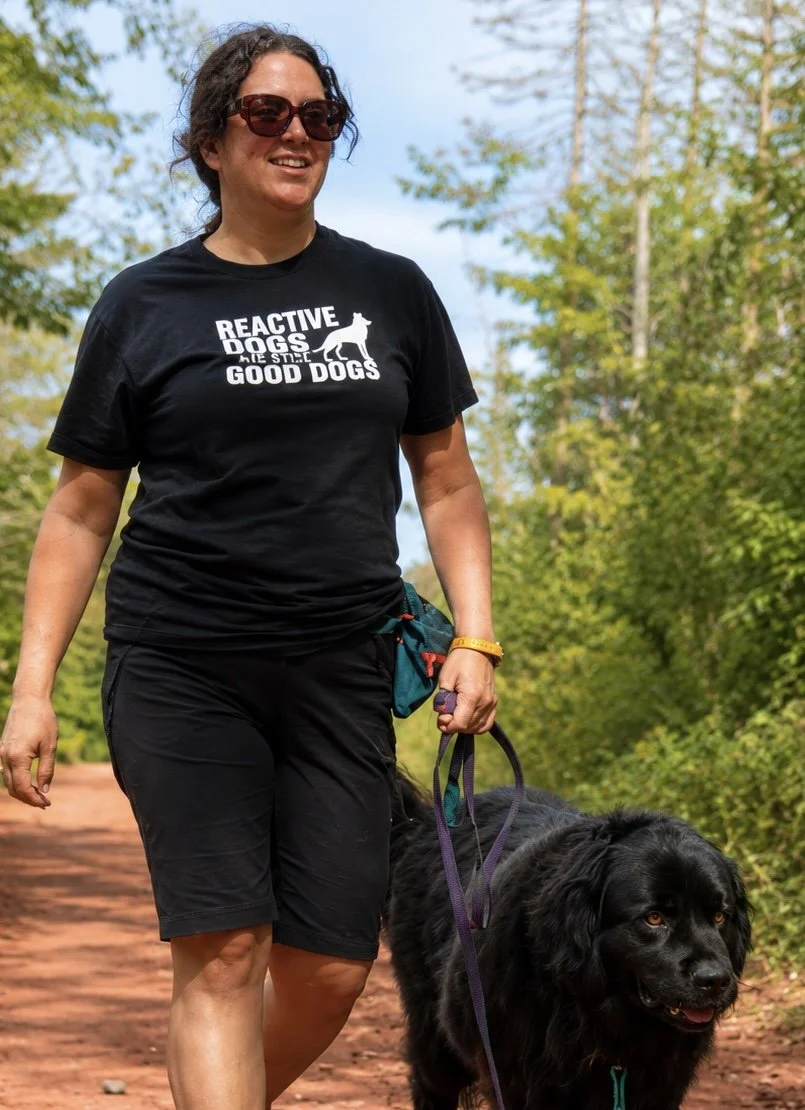
Reactive Dogs Are Still Good Dogs
Your dog sees another dog across the street.
Their body stiffens. They stare. Then suddenly they’re barking, lunging, growling and throwing themselves around at the end of the leash while you desperately try to regain control.
Everyone is looking.
The other owner gives you that look and moves their dog farther away. You’re embarrassed, frustrated and maybe wondering how you ended up here.
Here’s something I wish more owners of reactive dogs heard:
Your dog is not a bad dog!
Reactivity is a behaviour problem. It is not a character flaw.
And while living with a reactive dog can be incredibly difficult, there is a lot you can do to make life better for both of you.
What Does “Reactive” Actually Mean?
Reactivity describes a dog having an excessive response to something in their environment.
Dogs can be reactive to other dogs, people, bicycles, vehicles, wildlife, noises or any number of things.
The behaviour itself can look dramatic: barking, lunging, growling, spinning, screaming, pulling or becoming completely fixated on the trigger.
But those behaviours don’t necessarily tell us why the dog is reacting.
Some dogs are fearful. Some are frustrated. Some become overly excited. Some have learned that a big explosive display makes uncomfortable things move farther away. Others desperately want to reach whatever they’re seeing and become frustrated because the leash prevents them from doing so.
Two dogs can look almost identical at the end of the leash while experiencing very different emotions.
That’s why treating every reactive dog exactly the same doesn’t make much sense.
Reactivity and Aggression Aren’t Automatically the Same Thing
A dog who barks and lunges at another dog isn’t automatically a dog who wants to hurt that dog.
Reactive behaviour certainly can involve aggression, and aggressive behaviour should always be taken seriously. But reactivity and aggression aren’t interchangeable terms.
I’ve worked with plenty of dogs who look absolutely terrifying while restrained on leash and behave very differently once the situation is properly assessed and understood.
I’ve also worked with dogs whose behaviour presents legitimate safety concerns.
Part of good training is learning the difference rather than making assumptions based solely on how dramatic the reaction looks.
Stop Measuring Your Dog Against Everyone Else’s
One of the hardest parts of owning a reactive dog is watching other people seemingly have the dog experience you thought you were going to have.
They’re sitting on patios and walking through busy parks.
Their dog passes another dog on the sidewalk without turning into a frantic tornado.
Meanwhile, you’re strategically crossing streets, hiding behind parked cars and checking around corners before proceeding.
It can be discouraging but I’m hear to tell you that all those supposed awesome, friendly dogs you are seeing? THEY ARE THE MINORITY. The majority of people have a dog with some sort of issue. When you pay attention, you realize you are seeing the same dogs out and about all the time. It’s not hundreds of perfect different ones.
So comparing your dog to someone else’s dog isn’t particularly useful. Genetics, early experiences, socialization, previous learning, temperament and life experiences all contribute to the dog standing beside you today.
Your starting point is your starting point.
The important question isn’t whether your dog can currently do what somebody else’s dog can do. It’s whether you’re helping your dog become more capable than they were yesterday.
Distance Is Your Friend
One of the most important concepts in reactive-dog training is understanding threshold.
If your dog can see another dog 100 feet away and still eat food, respond to you and think clearly, you have an opportunity to train.
If you move twenty feet away and your dog is screaming, lunging and completely unable to acknowledge your existence, you’re probably not doing much productive teaching anymore.
That doesn’t mean your dog should avoid triggers forever. I don’t teach a system involving life long management and avoidance of triggers forever.
It means training needs to happen at a level where your dog is actually capable of learning.
Over time, that distance can change.
The goal is not to throw your dog into the hardest possible situation and hope they eventually get over it. It’s to progressively teach them how to handle situations they currently find difficult.
Management Isn’t Failure
Sometimes the best decision you can make is to cross the street.
Or turn around, skip the busy trail, tell someone that no, their friendly dog cannot come say hello.
Management keeps everyone safe and prevents your dog from repeatedly rehearsing the very behaviour you’re trying to change.
You don’t get bonus points for putting your dog into situations they’re not ready to handle.
Good training involves knowing when to work through something and when to say, “Not today.”
Your Dog Needs to Learn What to Do Instead
Telling a dog what not to do is not the whole picture.
Don’t bark, don’t lunge, don’t stare.
Okay. What should they do? This is where training becomes incredibly important.
I want reactive dogs to develop skills that give us something productive to work with around their triggers. That might include following leash pressure, moving with their handler, disengaging from something, being gently interrupted from hard staring, responding to known commands, recalling away from fixation or simply learning that they don’t need to make every decision themselves.
Food can be extremely useful in this process. So can appropriate training equipment. Depending on the individual dog, its history, the handlers skill and confidence, and the behaviour we’re addressing, I may use different tools and training techniques.
There isn’t one recipe for every reactive dog.
The goal is clearer communication, better choices, a dog who can recover quicker after triggers and a human and dog who increasingly knows how to handle difficult situations.
The Human End of the Leash Matters Too
Living with reactivity can change the way you behave on walks.
You start scanning constantly.
Oh god! There’s a dog coming!
Oh No! Someone opened a door!
Shit, There’s a person around the corner!
F*#k, Is that dog off leash?
Your dog’s reactions may become so stressful that eventually you’re anticipating the explosion before your dog has even noticed the trigger.
That’s understandable, but it can also make training harder.
Dogs are incredibly good at noticing changes in our movement, leash handling and behaviour. If you see another dog and immediately shorten the leash, tense your body and start frantically repeating your dog’s name, you’ve just communicated that something important is happening.
Part of reactive-dog training often involves coaching the human too.
Learning how to handle the leash, recognize early signs of fixation, intervene sooner and remain purposeful instead of panicked can make an enormous difference.
You don’t need to become completely emotionless. You just need skills and a plan.
Progress Doesn’t Always Look Impressive
Progress with a reactive dog isn’t always dramatic.
Sometimes progress is your dog seeing another dog and looking back at you. Wow!
Sometimes it’s recovering from a reaction in thirty seconds instead of five minutes. Yes!
Sometimes it’s passing at forty feet when you used to need eighty. Yay you!
Sometimes your dog still reacts, but the reaction is smaller and you can regain communication much faster. Woohoo!
Those things matter.
Behaviour change isn’t always a straight line, either. Your dog may have an amazing walk on Tuesday and struggle on Wednesday. Environment, distance, stress, excitement and previous events can all affect how much a dog can handle on a particular day.
Look at the overall trend rather than judging your entire training program by one bad walk.
Your Goal Doesn’t Have to Be a Dog Who Loves Everybody
This is a big one I say all the time.
Your reactive dog does not need to become a social butterfly.
They don’t have to play with every dog, greet strangers with delight, go play at the dog park. A full cure like this is possible for some, but not all dogs.
For many dogs, neutrality is a much more useful goal than sociability.
I don’t necessarily need your dog to see another dog and think, “Hey bestie!”
I’d much rather they learn, “There’s a dog over there. Cool. Moving on.”
A dog who can peacefully coexist around things without needing to interact with them has an enormous amount of freedom.
Don’t Wait Until Your World Gets Tiny
One of the saddest things about reactivity is how gradually it can shrink both the dog’s and owner’s lives.
First you stop walking at busy times, then you avoid certain trails, then you stop going places altogether because every outing feels stressful. I get it! I’ve been there before hiring a trainer!
If you’re struggling, getting help earlier can prevent months or years of rehearsing the same behaviour.
A good trainer can help determine what’s driving the reactions, identify appropriate training and management strategies, teach you how to read your dog and help you develop the handling skills you’ll need outside of a controlled training environment.
There isn’t a magic trick that makes reactivity disappear overnight.
But there can be tremendous improvement.
Your Dog Is More Than Their Worst Moments
A reactive dog might also be the dog who sleeps upside down on your couch lookin all cute.
The dog who makes you laugh every day with their goofiness.
The dog who adores your family and kids.
The dog who hikes with you, learns ridiculously fast, follows you from room to room or brings you their favourite toy when you get home.
The barking and lunging are part of the picture right now but that’s not the whole dog.
Reactivity can be frustrating. It can be embarrassing. It can be exhausting. And yes, sometimes it can be serious.
But reactive dogs are still good dogs. I will die on that hill.
Sometimes they just need someone to help them learn how to navigate a world they currently don’t know how to handle.
Peace, Love & Dogs,
Trainer Sara
