
Food Is a Training Tool: Why I Use Food in Dog Training
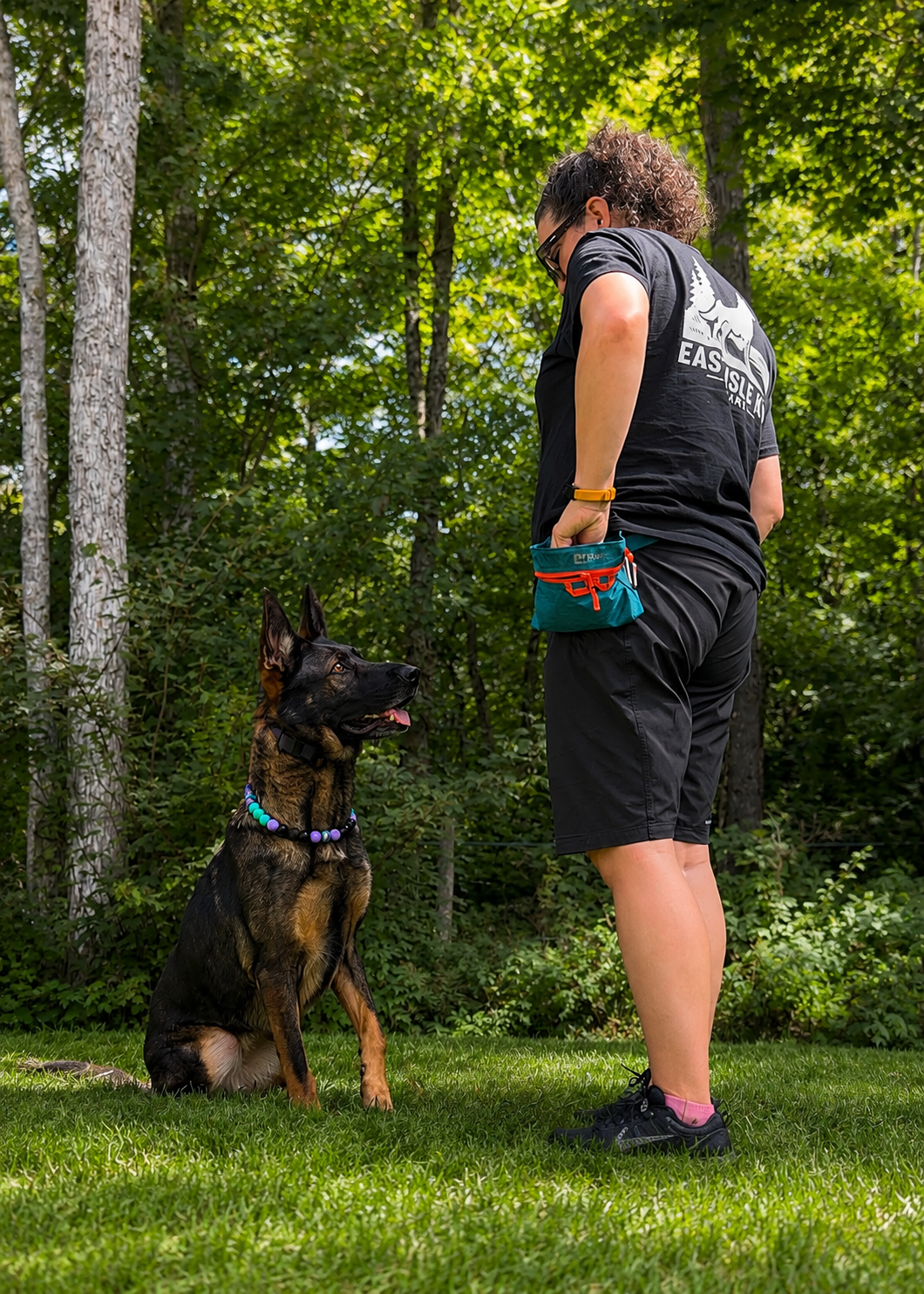
Food is one of my favourite dog training tools.
It’s not my only tool, and I’m certainly not suggesting that every dog should spend the rest of their life staring at a cookie before deciding whether they’re going to listen to you.
But when I’m teaching a dog something new, food can be incredibly useful.
There’s a reason positive reinforcement — R+ — is such a big part of how I train at East Isle K9. If I can make learning clear, motivating and rewarding for the dog, why wouldn’t I?
Dogs Like Getting Paid Too
Think about how most of us approach work.
You probably don’t show up every day purely because your boss said you’re a good person and gave you a pat on the head. There’s usually a paycheque involved.
Dogs aren’t all that different.
When I’m teaching a new behaviour, I want the dog thinking, Oh! When I do that, something good happens.
Food gives me a quick, clear way to tell a dog, “Yes. That right there. Do that again.”
As the dog becomes more experienced and the behaviour becomes more reliable, we can change how and when those rewards happen.
But while they’re learning? I’m happy to pay them.
I Don’t Want to Bribe Your Dog
There’s an important difference between using food as a reward and needing to show your dog food before they’ll do anything.
If I have to wave a piece of chicken in front of your dog’s nose every time I ask them to sit, we haven’t finished teaching the behaviour.
With young puppies especially, I may initially use food to lure a behaviour. That’s a useful way to help them understand what I’m asking. But I want to phase that lure out fairly quickly.
The food doesn’t need to stay in my hand.
It can stay in my pouch or pocket until the dog earns it.
I want the dog responding to me and my cues, not simply following a cookie around.
Your Dog Already Has a Training Budget
One of the easiest ways to incorporate food into training is to use something your dog is already getting every day: their meals.
I generally prefer scheduled meals rather than leaving a bowl of food available all day. Aside from the other benefits of having a feeding routine, your dog’s daily food can become a fantastic training resource.
Instead of automatically putting an entire breakfast into a bowl, I can take some of that food and use it to practise engagement, recall, place, leash skills, obedience or whatever we’re currently working on.
Your dog still gets fed.
We’ve just made some of those calories work for us.
For some dogs, I’ll use part of a meal for training and put the rest in the bowl. For others, especially during periods of concentrated training, a significant portion of their daily food may be earned through training.
Value Matters
If something is available constantly and for free, it generally becomes less valuable.
Food is no different.
A dog who has access to a full bowl all day may be considerably less interested when I pull out that exact same kibble and ask them to work for it.
That’s not about starving a dog or withholding something they need. Dogs need appropriate daily nutrition, and they should get it.
It’s about being thoughtful about how we deliver something the dog already values.
Training before a meal, for example, can give me a dog who’s naturally a little more motivated to work than one who just finished eating a giant dinner.
And motivation makes teaching easier.
But What If My Dog Doesn’t Care About Food?
Not every dog is highly food motivated, and even a dog who loves food at home may suddenly decide your cheese is worthless when you take them somewhere exciting.
That’s information.
Sometimes the environment is too difficult. Sometimes the dog is stressed, overstimulated or distracted. Sometimes we need a better reward. And sometimes food simply isn’t the thing that motivates that particular dog most, especially if food motivation wasn’t intentionally developed as part of their early socialization and training.
That’s where training the dog in front of you matters.
Food is an excellent tool, but it’s one tool.
I also use praise, play, movement, access to things the dog wants, training equipment, pressure and release, boundaries and appropriate non harsh corrections depending on the dog, the behaviour and where we are in the training process.
Being an R+ balanced trainer doesn’t mean I believe food can solve every problem.
It means positive reinforcement is an important part of how I teach.
Will I Have to Carry Treats Forever?
No.
At least, that’s certainly not my goal.
When your dog is first learning something, reinforcement should be frequent. They’re figuring out the rules of the game, and I want to make those rules very clear.
As their understanding and reliability grow, we can begin changing the reinforcement schedule. Food becomes less predictable, other rewards become more meaningful, and behaviours start becoming part of everyday life.
That doesn’t mean I stop rewarding my dogs once they’re trained. If my dog does something fantastic, I’m still perfectly happy to pay her for it. I do still take the pouch along when I take Kya out and about in public for some periodic rewards.
I get paid for doing a job I’ve known how to do for years too, so should she.
Food Is a Tool — Use It
Sometimes people seem almost embarrassed that their dog works well for food, as though the truly impressive dog should perform entirely out of love and respect for their owner.
I don’t see it that way.
If I have something my dog values and I can use it to make communication clearer, learning faster and training more enjoyable, I’m going to use it.
Food isn’t the whole training system at East Isle K9.
But it’s a very useful part of the toolbox.
Teach the behaviour. Reward the effort. Build understanding. Then gradually ask for more.
Peace, Love & Dogs,
Trainer Sara
